Actionable Guides and Tips for Successful
Offshoring to The Philippines
How AI-Enabled Global Capability Centres Strengthen Business Continuity and Operational Resilience
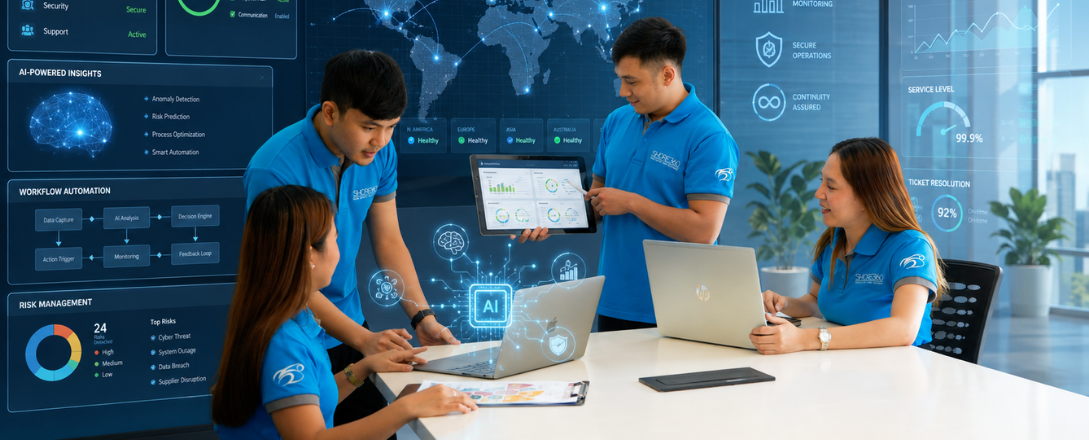
Business continuity now depends on workforce resilience.
A business may have reliable backups, secure systems and a detailed disaster recovery plan, yet still be unable to complete payroll, answer urgent customer enquiries or deliver critical reports when key employees become unavailable.
This is the gap many traditional business continuity plans overlook.
PwC’s Global Crisis and Resilience Survey found that 91% of organisations surveyed had experienced at least one major disruption beyond the pandemic. More than three-quarters said their most serious disruption had a medium-to-high impact on operations. Yet 70% of business leaders remained confident in their organisation’s ability to recover, suggesting that perceived preparedness does not always reflect operational reality.
Business continuity has traditionally focused on protecting data, restoring technology and recovering physical infrastructure. These measures remain essential, but they do not fully address whether an organisation has the people, knowledge and capacity required to keep essential work moving.
Employee absences, skills shortages, local emergencies, system outages and unexpected demand can quickly expose weaknesses in an operating model. The risk is particularly high when a business relies on one location, a limited talent market or a small number of employees who hold critical operational knowledge.
The consequences may include more than temporary delays. A missed payroll run can affect employee trust. An unanswered escalation can place an important customer relationship at risk. A delayed compliance report can create financial or regulatory exposure. Even when the technology remains available, the business may still be unable to operate effectively.
AI-enabled Global Capability Centres offer a more resilient approach. They combine skilled global teams, structured workflows, distributed delivery, secure systems and practical AI to help organisations maintain critical services when operating conditions change.
AI can help teams retrieve knowledge, organise information and complete suitable routine activities more efficiently. However, resilience does not come from technology alone. Human judgement, clearly documented processes, secure access and defined accountability remain essential.
Shore360 helps businesses bring these elements together through integrated global capability, practical AI adoption and workforce transformation. The objective is not simply to recover after disruption. It is to build flexibility and continuity into the way work is delivered every day.
Why traditional continuity plans leave workforce gaps

A business can restore its technology and recover its data but remain unable to operate if the people responsible for essential processes are unavailable.
This is especially risky when payroll, customer escalations, financial reporting or compliance activities depend on one or two employees. Even a short absence can cause missed deadlines, backlogs and service disruption when responsibilities, system access and process knowledge cannot be transferred easily.
Common workforce vulnerabilities include:
- Critical knowledge concentrated among a small number of employees
- Limited cross-training between roles or departments
- Manual or undocumented processes
- Dependence on one office or local talent market
- Insufficient capacity during demand spikes
- Unclear handover and escalation procedures
For example, a professional services firm may rely on one senior employee to prepare monthly client reports. If the process is manual and poorly documented, another team member may be unable to take over quickly, even when all systems remain available.
Modern continuity planning must therefore answer three practical questions:
What work must continue?
Identify the activities that directly affect customers, employees, compliance, cash flow and revenue.
Who can perform the work?
Critical responsibilities should not depend entirely on one employee, team or location.
How can responsibilities be transferred?
Processes, access requirements, decision rules and escalation pathways must be clearly documented.
Workforce resilience closes the gap between having a recovery plan and being able to continue operating through disruption.
What is an AI-enabled Global Capability Centre?

A Global Capability Centre is a dedicated operation that supports important business functions as an integrated extension of the organisation.
Rather than completing isolated tasks, its teams work within the organisation’s systems, processes and performance standards. Over time, they develop a deeper understanding of its customers, priorities and operational requirements.
Depending on the organisation, a Global Capability Centre may support finance, customer service, human resources, recruitment, marketing, information technology and business operations.
An AI-enabled Global Capability Centre strengthens this model by combining skilled professionals with artificial intelligence, automation and workflow design.
Shore360 expresses this through a simple framework:
People + AI + Process = Smarter Business Outcomes
People provide judgement
Employees understand context, manage exceptions and make decisions requiring empathy, business knowledge and professional judgement.
AI creates capacity
AI can help teams retrieve information, organise data, summarise documents, prepare initial reports and identify exceptions. This reduces routine work and gives employees more time for analysis, problem-solving and customer relationships.
Processes create reliability
Technology cannot improve a workflow that is unclear or poorly designed. Responsibilities, approvals, handovers and escalation points must be defined before AI or automation is introduced.
Together, these elements create a more flexible capability that can maintain services and adapt as workforce availability or demand changes.
Four ways global capability strengthens resilience

- Maintaining critical services
Integrated global teams can help maintain customer support, finance administration, reporting, recruitment coordination and IT services when local capacity is reduced.
Because these teams already understand the organisation’s systems and processes, they can provide more reliable support than an emergency solution introduced after disruption occurs.
The value is not simply additional headcount. It is access to an established capability that can help essential work continue.
- Reducing key-person dependency
Critical knowledge often sits with a small number of employees. When that knowledge is difficult to access, absences can delay work and place pressure on the wider team.
Documented workflows, shared knowledge systems, cross-training and AI-assisted knowledge tools make information easier to transfer.
An authorised employee might use an internal AI tool to retrieve approved procedures or previous case information. The employee remains responsible for assessing the situation, but no longer needs to rely entirely on another person’s memory.
- Responding to changing demand
Disruption can increase workloads rather than reduce them.
A logistics delay may generate a surge in customer enquiries. A system outage may create a transaction backlog. Seasonal demand may place pressure on service and administration teams.
A scalable global capability allows suitable work to be redistributed across teams and locations. AI can also help classify requests, prepare initial information and route urgent cases.
Employees can then focus on complex issues, communication and decision-making while routine work moves more efficiently.
- Improving knowledge and visibility
Businesses cannot respond effectively when information is fragmented across emails, spreadsheets and disconnected systems.
AI-enabled knowledge tools and structured workflows can help teams retrieve approved procedures, identify overdue work and highlight emerging bottlenecks.
This gives leaders better visibility over workloads and capacity, enabling them to respond before a small issue becomes a larger disruption.
AI should support these decisions rather than make high-risk decisions without human oversight.
Governance turns distributed delivery into resilience

Distributed delivery reduces dependence on one office, labour market or operating environment. However, geographic distribution alone does not create business resilience.
Without clear governance, teams may follow different procedures, use inconsistent information or be uncertain about decision-making authority.
A continuity-ready distributed model requires:
- Standardised workflows and service expectations
- Secure, role-based access to systems
- Clear data-handling and AI usage policies
- Defined responsibilities and approval requirements
- Documented handover and escalation procedures
- Human review of important AI-generated outputs
- Regular continuity testing and process reviews
Human oversight remains particularly important for decisions affecting customers, employees, finance, compliance or reputation.
For example, AI may flag an unusual transaction, but a qualified employee should determine the appropriate action. A customer service tool may suggest a response, but an employee should confirm that it is accurate and appropriate.
Governance allows organisations to benefit from speed and flexibility without weakening quality, security or accountability.
How Shore360 supports continuity-ready operations

Shore360 helps organisations build more resilient operating models by combining global capability teams, practical AI, workflow transformation and distributed delivery.
Integrated global capability teams
Shore360 develops dedicated teams that operate within each client’s systems, workflows and performance standards.
The objective is to build long-term capability that strengthens existing teams and provides greater flexibility when employee availability or workloads change.
Practical AI adoption
Shore360 begins with the business problem rather than the technology.
AI and automation are introduced where they can improve knowledge access, reduce repetitive administration, organise information or help teams manage high-volume work more effectively.
Employees retain responsibility for context, review and final decisions.
Workflow transformation
Shore360 reviews how critical work moves across people, systems and locations. This helps identify bottlenecks, duplicated effort, knowledge gaps and processes that rely too heavily on manual handovers.
Workflows can then be redesigned to improve consistency, visibility, knowledge transfer and scalability.
Distributed delivery and continuous improvement
Shore360’s regional delivery capability across the Philippines provides businesses with access to skilled professionals beyond a single location or labour market.
Supported by secure systems and consistent governance, distributed teams can help maintain priority services during disruption or temporary capacity constraints.
Shore360 also provides ongoing optimisation to ensure teams, AI capabilities and workflows continue to meet changing operational needs.
Build resilience into everyday operations

Business continuity is strongest when resilience is embedded in everyday work rather than activated only after disruption.
AI-enabled Global Capability Centres help businesses reduce operational dependencies by combining skilled people, distributed delivery, documented workflows, secure systems and practical AI.
The result is a more adaptable operating model that can maintain critical services, transfer responsibilities and respond when workforce availability or demand changes.
Speak with Shore360 about assessing your workforce continuity risks and building an AI-enabled Global Capability Centre that supports more resilient operations.